
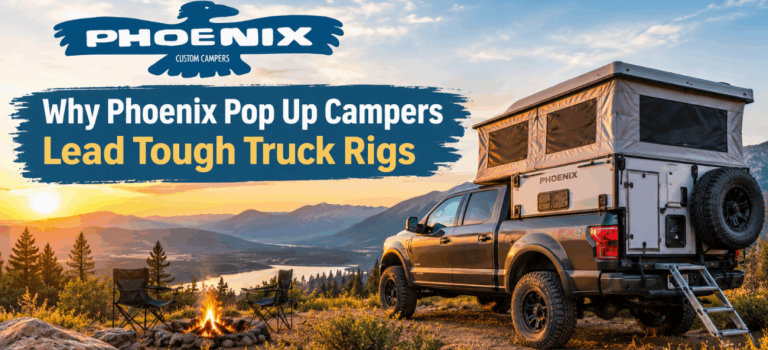
Phoenix pop up campers are direct-to-chassis, light truck toppers built for off-road strength, severe weather safety, and complete off-grid independence. Made with double-welded aluminum frames and Azdel wall panels, these rigs fit right into your truck bed to lower the center of gravity and protect payload limits. This specific build process lets overland travelers and outdoor lovers tackle rough dirt trails without giving up essential living comforts like thermal insulation, lithium solar power, and full sleeping space.
Table of Contents
- Why Do Standard Heavy RVs Fail on Off-Road Trails?
- How Do Thermal Pop-Up Walls Handle High Mountain Weather?
- How Does Lightweight Construction Improve Steering and Safety?
- What Are the Key Off-Grid Features for Remote Camping?
- Ready to Build Your Camper?
- Frequently Asked Questions
Why Do Standard Heavy RVs Fail on Off-Road Trails?
When shopping for quality truck campers, the main worry for trail explorers is finding a lightweight unit that handles constant off-road bumps without hurting vehicle springs. Common factory RVs use staples and glue that come apart under off-road stress. By comparison, phoenix pop up campers start with a hand-welded aluminum cage frame that moves naturally with your truck frame. This built-in flex stops seam cracks, metal stress, and water leaks over thousands of dirt trail miles.
A slim lower profile cuts down air drag, saving gas on highways and preventing dangerous wind sways on open roads. Units are made to match your truck Gross Vehicle Weight Rating, preventing early shock wear or frame damage over time. Cabin space is planned around your travel needs, holding built-in lithium batteries, fresh water tanks, and gear storage cleanly inside the truck bed profile. By choosing a dedicated truck build over a heavy box RV, truck owners protect their vehicle investment while reaching remote backcountry spots regular campers cannot touch.
The internal layout utilizes space efficiently without adding unnecessary weight. Birch cabinetry, solid surface countertops, and convertible seating areas give you a functional kitchen and living area that stays firmly anchored even on uneven terrain. Heavy-duty internal ratchet straps attach directly to 12,000-pound rated D-rings inside the truck bed, keeping the exterior free of ugly metal turnbuckles while preventing any movement during sharp turns or steep climbs.
How Do Thermal Pop-Up Walls Handle High Mountain Weather?
Unpredictable weather requires strong thermal protection in off-grid shelters. According to official weather studies from the National Oceanic and Atmospheric Administration (NOAA), quick temperature changes and sudden storms regularly affect seasonal outdoor travel across North American trails. To keep indoor temperatures comfortable in any climate, these pop-up units use multi-layer thermal walls alongside double-pane windows.
The pop-up side wall uses a triple-layer insulated fabric with built-in reflective heat shields. This design traps warm air inside during cold winter nights and blocks heavy desert heat during summer days. These insulated fabric walls work together with built-in heaters and 12-volt fridge units. By stopping indoor water droplets and keeping water lines safe from cold snaps, these truck rigs stay fully usable through all four seasons without freezing your water tanks or trapping excess moisture.
An electric push-button roof lift system makes raising and lowering the top simple, even when gear racks, solar panels, or kayaks are mounted up top. Once raised, the interior gives you over six feet of standing headroom alongside large side windows that offer full airflow and broad views. When closed down for driving, the low roof sits below branch height, shielding your vehicle from low tree limbs on narrow timber paths.
How Does Lightweight Construction Improve Steering and Safety?
Keeping weight balanced over front and back axles is critical when driving up steep trails or through deep washouts. Transportation safety rules from the Federal Highway Administration (FHWA) show that driving a truck near or over its maximum weight limit increases braking distance and makes steering much harder. Modern manufacturing solves this problem by using light Azdel composite boards and high-density foam instead of heavy wood particle boards.
This lightweight build style keeps dry weight low compared to standard hard-sided units. Drivers keep plenty of weight capacity for extra water, recovery tools, camping gear, and supplies without going over vehicle safety limits. Strong internal strap systems hold the load low and steady, giving drivers full steering control over rough dirt tracks and tight mountain switchbacks.
By choosing Azdel wall paneling over wood, these rigs eliminate the risk of mold, rot, or water damage if rain enters through open doors or windows. Azdel panels weigh half as much as traditional wood backings while providing higher insulation values. This structural choice reduces overall vehicle sway, easing stress on your truck’s transmission, brakes, and suspension systems during long cross-country drives.
What Are the Key Off-Grid Features for Remote Camping?
Staying off the grid for days or weeks requires self-contained energy and water solutions that operate without campground hookups. Quality truck campers solve this by integrating high-efficiency solar power systems directly into the roof design. Rooftop solar panels generate clean electricity throughout the day, feeding deep-cycle lithium battery banks that power lights, water pumps, refrigerators, and electronic devices continuously without needing noisy gas generators.
Fresh water storage is installed low inside the insulated floor cavity to protect water supplies from freezing and maintain a low center of gravity. Dual-way refrigerators run efficiently on direct 12-volt battery power or propane gas, preserving fresh food for extended backcountry stays. Built-in forced-air furnaces deliver steady heat with low power draw, keeping the interior warm during freezing mountain nights without draining your battery storage overnight.
For complete self-reliance, optional indoor showers and cassette toilet systems provide private bathroom facilities inside a compact space. The cassette toilet uses an easily removable waste tank accessible from the outside of the camper, allowing quick, clean emptying at standard rest stops or dump stations without requiring specialized hose hookups. Combined with efficient LED lighting and low-draw ventilation fans, these features give travelers true freedom to stay off-grid comfortably.
Ready to Build Your Camper?
At Phoenix Pop Up Campers, we build heavy-duty, off-road truck campers tailored to your exact vehicle and adventure goals. Contact our Colorado workshop today to start planning your build.
- Website: phoenixpopup.com
- Direct Line: (303) 286-3921
- Email: contact@phoenixpopup.com
Frequently Asked Questions
Q. What makes Phoenix pop up campers different from regular RVs?
Each unit is built from the ground up to match your exact truck bed size. Built with double-welded aluminum frames and Azdel walls, they give you off-road durability, lighter weight, and practical layouts that standard factory RVs cannot match.
Q. How do quality truck campers hold up in cold winter weather?
Quality truck campers use triple-layer insulated soft walls with heat-reflective layers, double-pane windows, and high-efficiency heaters. This design holds heat inside, stops indoor dampness, and protects water systems during cold winter camping.
Q. Can a pop up camper be made for any truck model?
Yes. Pop-up units can be built for mid-size, full-size, short bed, long bed, and flatbed truck models. Every frame is shaped around the exact bed lines and payload limits of your specific truck.
Q. How does a low-profile truck camper help gas mileage?
A low-profile pop-up shape reduces front wind resistance compared to tall hard-sided RVs. This slick profile saves fuel on high-speed roads and keeps the vehicle stable during strong side winds.